Special Projects
Organic Cotton Project:
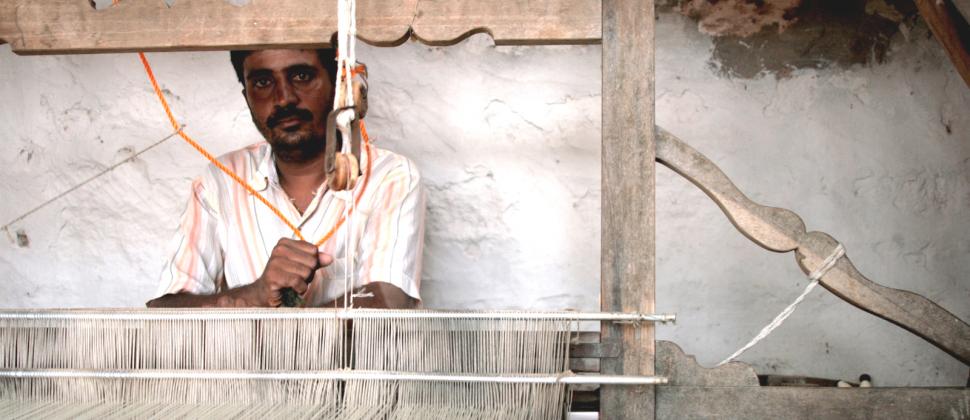
Kachchh is drought prone, semi arid region also world famous for its rich craft tradition. The region was severely hit by a massive earthquake in 2001. The reconstruction process of the region through rapid industrialization has badly hit the existing crafts. Many craftsmen have lost their raw materials, skilled human resources to highly competitive market forces. The KHAMIR Craft Resource Centre was established to revitalize and reposition the crafts of Kachchh. As the weavers of Kachchh were among the main loosers, KHAMIR launched a program to support the weavers of the region.
Weavers across Kachchh were identified in order to support the decaying craft. Production support, R&D and subsequent market linkages were provided to them after assessing the needs. From the results KHAMIR felt that new product innovation based on developed local strengths and supply chains could create an USP for the weavers. One such innovation is the use of high value organic cotton grown in Kachchh as raw material to produce woven & naturally dyed products.
Also, Kachchh is one of the few regions left in the country which produces short-staple organic cotton. This drought-prone, semi arid region with an annual rainfall of less than 350mm has ensured that more than 85% of its agricultural cultivation is rain-fed. Apart from other crops, the cotton growers are concentrated around Adesar of Rapar block. By default, the cotton growers of the region do not use any fertilizers, pesticides for production processes and is naturally organic. Kachchh Nav Nirman Abhiyan through its Setu Programme, and Satvik a knowledge resource group for sustainable farming, has now ensured organic certification for around 1000 farmers in east Kachchh.
This initiative was conceived as a common linkage between two major traditional livelihood groups of Kachchh – The weavers and the farmers. There was a traditional interdependence between communities in the past. However, due to changing economies, and shifts in livelihood patterns traditional livelihoods no longer sustain each other through a chain of inter dependency. KHAMIR, in partnership with SATVIK and SETUs is enabling the organic cotton farmers to integrate their produce with the craft of the weavers by which organic cotton can be produced in Kachchh itself, benefiting two sets of livelihood practitioners.
Plastic recycling through traditional weaving and other craft skills
Plastic weaving is an innovative contemporary concept using the traditional skills of weaving. KHAMIR has conceived and promoted it as a possible solution to modern problems through the usage of traditional weaving/craft skills. This also creates economic opportunities for marginalized weavers and urban waste collectors/rag pickers.
The plastic weaving is being carried out on traditional pit looms as well as frame looms. Strong plastic thread/or cotton is used for the warp and assorted plastic waste is the weft. Currently, there are two types of plastics used in the plastic weaving – plastic collected from garbage and industrial waste plastic.
The plastic collected from garbage in urban areas provides employment to the plastic waste collectors, area committees, schools, nearby industries. The collected plastic is then transported to KHAMIR where it is cleaned and segregated on the base of colour and quality. The cleaned plastic is then cut into long strips by the women of surrounding villages. The plastic strips of different colours are given to weavers to weave them. The various products are developed at the stitching unit of KHAMIR from the woven plastic sheets.
Plastic weaving has potential to recycle the huge plastic waste while creating income generation opportunities for local people. There are many aspects related to colour, quality etc. that are required to be fixed before going for big scale production. There is a strong need of design interventions to identify application of hand woven recycled plastic products. The various products can be developed are school bags, carry bags, file folders, diary covers etc. This is a skill that can be easily learnt by neo-weavers and can become a source of supplementary income to medium skilled weavers, home-based workers, disabled and senior citizens.